
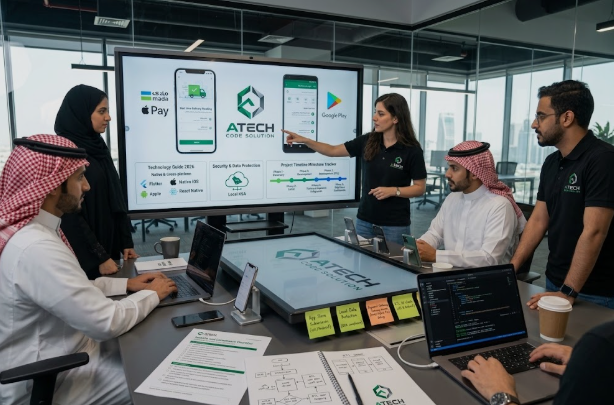
A business can have a good app idea and still end up with the wrong product.
This usually happens before development even starts. The company chooses a technology, asks a few developers for a price, and then tries to fit the business idea into whatever the quotation includes.
For businesses in Saudi Arabia, there are a few more things to think about. Will customers use the app in Arabic or English? Do you need payments inside the app? Will users need identity verification? Does the app need a web dashboard as well? Who will maintain it after launch?
Getting those decisions right early can save a lot of time and money later.
What Kind of App Are You Building?
The phrase “mobile app development” covers very different products.
A restaurant ordering app is not built like a banking application. A delivery platform has different requirements from an internal employee app. Even two ecommerce apps can have very different technical needs.
A typical project may include the customer app, backend system, admin panel and integrations with external services.
That is why a good mobile app development company in Saudi Arabia should first understand the business process rather than immediately discussing programming languages.
A useful starting point is to define the main user action.
Are people booking something? Buying products? Sending money? Tracking deliveries? Managing their accounts? Using the app as part of an internal business process?
Once that is clear, the required features become much easier to define.
How Much Does Mobile App Development Cost in Saudi Arabia?
There is no standard price for app development in Saudi Arabia.
A relatively simple application can be very different from a product with multiple user types, real-time tracking, payments, messaging, and a large backend.
The budget is usually affected by things such as the number of screens, complexity of the user experience, backend requirements, integrations, and the platforms you want to support.
For example, building both iOS and Android can mean more development and testing, although a cross-platform approach can reduce duplicated work for some projects.
Another cost that businesses sometimes overlook is everything that happens after the app is launched.
There will be updates, bug fixes, operating system changes, security work, and new feature requests. It is worth discussing ongoing support before signing the initial development agreement.
So instead of asking only, “How much does an app cost?” ask what you are getting for that amount.
Does the App Need Arabic?
For many Saudi businesses, this should be decided at the beginning.
Arabic support is more than translating the English copy. The interface needs to work properly in a right-to-left layout, including navigation, forms, menus, buttons, and other components.
It is also useful to think about the content itself.
Some businesses will have the same message in both languages. Others may need different wording depending on how Arabic and English users search, read, and interact with the product.
A properly planned Arabic-first mobile app or bilingual app should be designed with both experiences in mind instead of treating Arabic as a final-stage addition.
What About Mada, Apple Pay and Local Payments?
Payment requirements depend heavily on the app.
An e-commerce application obviously needs a payment flow. A booking platform may need deposits or complete online payments. Some apps may not require payments at all.
For Saudi-focused applications, businesses commonly consider payment options such as Mada, Apple Pay and other local or regional payment services. The exact integration depends on the payment provider, business model, and technical setup.
This needs to be discussed before development begins.
Changing the payment architecture halfway through a project can affect both the backend and the user experience.
The same principle applies to other third-party systems. If the app needs maps, CRM integration, notifications, accounting software, or another external service, the development team should know about it during planning.
iOS, Android, or Both?
This decision is often made too quickly.
If your customers use both major mobile platforms, building for both may be the obvious choice. The more interesting question is how you build them.
Native iOS and Android development gives developers direct access to each platform. Cross-platform frameworks can allow much of the codebase to be shared.
There is no universal winner.
For one product, native development may make more sense. For another, a cross-platform approach may help reduce development time and simplify maintenance.
A professional developer should explain the trade-offs in relation to your app, not simply recommend the technology they happen to prefer.
How Long Does App Development Take?
The timeline depends on how much there is to build.
A basic application with a limited number of screens can move fairly quickly. A larger product with multiple user roles, backend services, payments, dashboards, and third-party integrations can take several months.
The development itself is only part of the process.
Planning, UX design, revisions, testing, and app-store submission also take time.
This is why it is better to ask for milestones than a vague promise such as your app will be ready in eight weeks.
A sensible plan might separate discovery, UI/UX, development, testing, and launch preparation. It gives the business a better understanding of where the project stands and where delays are occurring.
What Features Should You Plan Before Development?
A useful app doesn’t need every possible feature.
It needs the right features.
Before development starts, write down the main actions users should be able to complete. Then add the functions required to support those actions.
For example, an ecommerce app might need:
- Product browsing
- Search and filters
- Customer accounts
- Cart and checkout
- Payment
- Order tracking
- Notifications
A delivery business could need location tracking, driver accounts, dispatching, and real-time status updates instead.
This exercise often removes features that sound impressive but do not solve an actual customer problem.
What About Security and User Data?
Security should be part of the architecture, not something added after the first version is complete.
The requirements depend on what information the application handles.
An app dealing with customer accounts, payments, or sensitive personal information needs a different level of planning from a simple content application.
Saudi businesses should also consider applicable local data protection and regulatory requirements based on their industry and the type of data being processed.
That may affect authentication, storage, access control, logging, and third-party integrations.
What Should You Ask a Mobile App Development Company?
Before choosing a custom mobile app development company in Saudi Arabia, ask a few questions that are easy to overlook.
Who owns the source code?
Will you receive access to the backend and admin panel?
Is Arabic RTL support included?
Who will publish the app on the App Store and Google Play?
Which integrations are included in the quotation?
What happens when something breaks after launch?
How are updates handled when iOS or Android changes?
What support is available after the first release?
These answers can tell you more about the development partner than a portfolio full of screenshots.
Why A Tech Code Solution?
A Tech Code Solution approaches app development around the actual business requirement.
That starts with understanding the user journey, required features, integrations, and future plans before deciding how the application should be built.
For a Saudi project, the conversation can also include Arabic UX, local payment requirements, backend architecture, app-store publishing, and ongoing support.
That planning stage matters because a mobile app is not finished when it appears in the App Store. The product still needs maintenance, monitoring, and improvements as customers start using it.
Final Thoughts
The cheapest app is not always the cheapest project.
A low initial quotation can become expensive when essential features, integrations or post-launch support were never included in the scope.
Businesses looking for mobile app development in Saudi Arabia should first define the problem the app is supposed to solve, who will use it and which functions are genuinely necessary.
Once that is clear, it becomes much easier to choose between native and cross-platform development, estimate the budget, and compare companies properly.
For a serious app project, the development partner should be able to explain not only how they will build the product but also how that product will be maintained after launch.