By the A Tech Code Solution team | Last updated: November 2026 | 7 min read
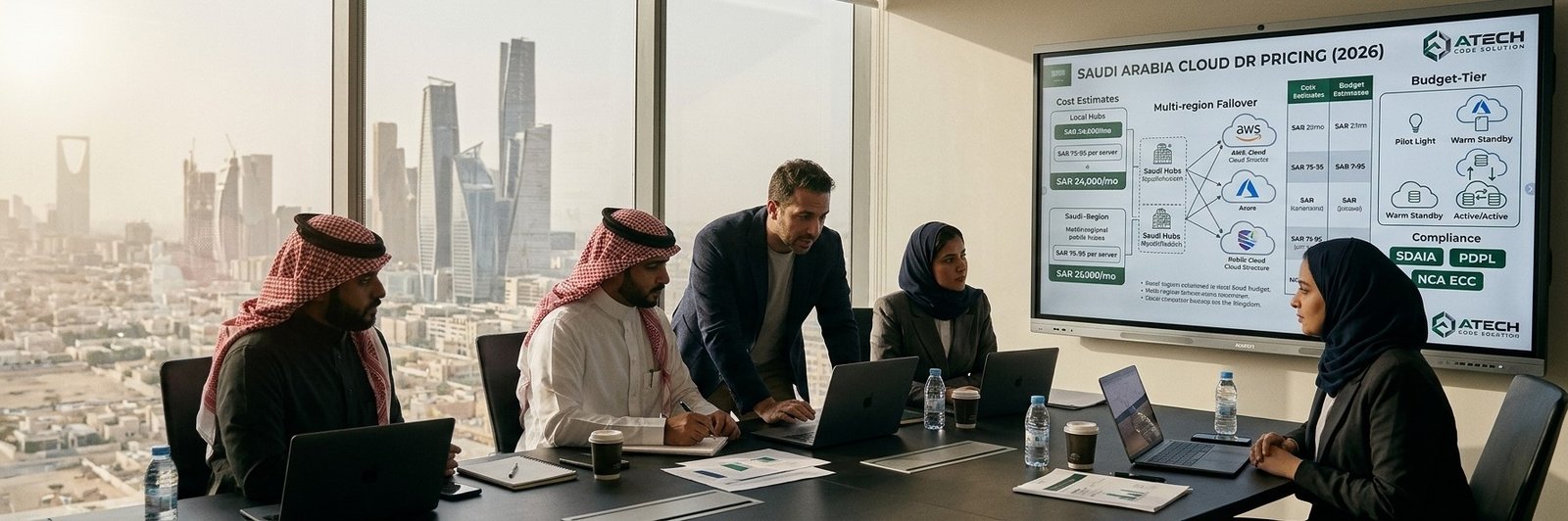
Cloud disaster recovery pricing in Saudi Arabia isn’t one number. The replication software is cheap, about SAR 75 to SAR 95 per server a month on AWS and Azure. The full bill is usually around three times that once you add storage, snapshots and test drills. Two things move it the most: how fast you need to be back online, and whether your recovery site has to stay inside the Kingdom.
Here are the real numbers, what pushes them up, and how to get quotes you can compare.
How much does cloud computing disaster recovery cost in Saudi Arabia?
Start with the public price lists. They’re the only hard numbers you can check yourself. The prices below come straight from AWS and Microsoft in US dollars. I’ve converted them at the fixed rate of 3.75 riyals to the dollar, and 15% VAT is extra where it applies.
| What you pay for | Provider’s price | About in SAR |
| AWS Elastic Disaster Recovery, per server | $0.028 per hour, about $20.44 a month | SAR 77 a month |
| Azure Site Recovery to Azure, per protected machine | $25 a month, free for the first 31 days | SAR 94 a month |
| An 8-hour test drill for 100 servers on AWS | $122.94 | SAR 461 |
| AWS’s example: 100 servers, 30 TB, all charges included | About $6,400 a month | About SAR 24,000 a month |
The first two lines are only the replication fee. Your real bill also has the storage that holds the copies, the snapshots that let you roll back, and the small servers that keep the data in sync. AWS shows this in its own worked example. The replication fee was $2,044 a month out of a total of about $6,400, so roughly a third.
AWS built that example on its US East prices. A Saudi region may price differently, so use it to understand the shape of the bill, not as a quote.
For a smaller company, scaling the same example down to 10 servers and about 3 TB gives roughly $640 a month, or about SAR 2,400. That’s my own rough scaling, and it assumes the same rate of data change. Your number could be higher or lower.
These numbers leave out the time to set it up and run drills, licences at the recovery site, outbound data transfer and any compliance work. The next section covers those.
What decides your disaster recovery bill?
Recovery speed comes first. A system you can restore from backup over a day costs far less than one that has to be back in minutes. The next section breaks down the options.
Data size and change rate come second. You pay to store the copy, and you pay for the snapshots that let you go back to an earlier point. In AWS’s example, snapshot storage (2,044).
Licences catch people out. If you recover Windows Server or SQL Server at the recovery site, those servers need to be licensed there. Microsoft’s Disaster Recovery Software Assurance benefit can cover this for customers with active Software Assurance, but only for non-production DR use, and test recoveries are limited to one week every 90 days. Ask your licence reseller before you sign anything.
Data transfer depends on the platform. Azure charges for outbound data when traffic leaves a region, so replicating between two Azure regions can add transfer fees. AWS says the transfer cost of a drill is usually small next to its other costs, although it varies.
Drills and real failovers cost money only while they run. Neither AWS nor Azure bills recovery compute until you launch a drill or a real failover. AWS puts an 8-hour drill for 100 servers at about $123, or SAR 461. That’s cheap enough that cost is a poor reason to skip testing.
Then there’s the cost that never shows up on a price list, which is people. Someone has to set it up, test it, and fix it when replication fails. For a small team without a cloud engineer, that can outweigh the software fee.
Which disaster recovery setup fits which budget?
AWS’s Well-Architected guidance describes four strategies. The names are AWS’s, but the idea applies on any platform.
| Strategy | Data you could lose | Time to recover | Relative cost |
| Backup and restore | Hours | Up to 24 hours | Lowest |
| Pilot light | Tens of minutes | Tens of minutes | Low |
| Warm standby | Seconds | Minutes | Medium |
| Multi-site active/active | Near zero | Near zero | Highest |
The ranges are indicative and come from AWS’s guidance.
Most small and mid-size businesses don’t need the whole ladder. I’d split systems into two groups. The systems that earn you money, like your order system, ERP or customer database, go on pilot light. Everything else, like file shares and internal tools, goes on backup and restore.
Active/active is for banks and large platforms, where an hour offline costs more than the whole DR budget. AWS itself calls it the most complex strategy and says to choose it only when the business requires it.
If you’re still weighing public, private and hybrid, our guide to public vs private vs hybrid cloud in Saudi Arabia explains the differences.
Does your recovery site have to stay inside Saudi Arabia?
This question changes the quote more than any other.
Under the PDPL, personal data can leave the Kingdom, but only under conditions. SDAIA’s transfer regulation, updated in September 2024, asks for a legal basis and safeguards, and in many cases a risk assessment. Regulated sectors like banking can also face local-hosting rules from regulators such as SAMA. If you’re not sure where you stand, ask your compliance team before you pick a recovery region.
One proposal is worth watching. SDAIA has proposed changes to the PDPL’s implementing regulation, and law firms point out that a local-copy requirement, if it’s added, could affect backups and disaster recovery. It’s a proposal, not law, so don’t plan around it yet.
Here’s where the in-country options stand:
- Oracle has two live regions in Saudi Arabia, Jeddah and Riyadh, and it markets them as a pair for disaster recovery that keeps data in the country.
- Google Cloud’s Dammam region has been live since November 2023. Customers based in Saudi Arabia buy it through its reseller, CNTXT.
- Microsoft says its Saudi Arabia East region, in the Eastern Province with three availability zones, will open in November 2026.
- AWS says its first Saudi region is on track for December 2026.
- Local providers such as Sahara Net list disaster recovery configurations across their Saudi data centres.
As of 27 November 2026, I couldn’t find confirmation that the Azure or AWS regions are open to customers. Azure’s Site Recovery pricing page doesn’t list Saudi Arabia East yet either. Check both before you plan around them.
One more thing that’s easy to miss. Three availability zones in one region protect you if a data centre fails. They don’t protect you if the whole region has a problem. AWS says that if you worry about a region-wide event, or regulation requires it, you should look at pilot light, warm standby or active/active across regions. For a regulated Saudi company that wants its data to stay in the Kingdom, that means two sites inside the Kingdom. It’s why a hybrid setup with a second site at a local provider is worth pricing too. Our hybrid cloud provider guide shows how to compare them.
What do Saudi rules say about backup and disaster recovery?
If your organisation falls under the NCA’s Essential Cybersecurity Controls, backup isn’t optional. The ECC has a backup and recovery management control, and its business continuity requirements include having disaster recovery plans.
The NCA has also issued newer controls for private companies that aren’t critical infrastructure, called NCNICC-1:2025. Law firms say they reach small, medium and large businesses, so check which set applies to you.
This is general information, not legal advice. Confirm with your compliance team.
How do you get quotes you can actually compare?
Prices only compare when every provider quotes the same thing. Before you contact anyone, write down:
- Each system you want to protect, and how much data it holds
- How much of that data changes in a day
- For each system, how long it can be down and how much data you can afford to lose
- Whether the recovery site must stay inside Saudi Arabia
- Which Windows, SQL or other licenses you run
Then ask every provider the same questions in writing:
- What’s in the monthly fee, and what’s billed separately?
- What does a drill cost, and how many are included?
- What does it cost to fail back to your main site afterwards?
- Is outbound data transfer charged?
- Who runs the failover, and are they available 24/7?
- What happens to my data and my fees if I leave?
Ask for a three-year total, not just the first month. A cheap start with expensive extras gets costly quickly. If you’re also moving systems into the cloud, our cloud migration cost guide covers that side.
Where do businesses overspend on disaster recovery?
Treating every system the same is the usual one. A file share and an order system don’t need the same recovery time, so they shouldn’t cost the same.
The second is buying warm standby when pilot light would do. Ask what an hour of downtime really costs your business. If nobody can answer, you’re guessing at the budget.
The third is mixing up backup and disaster recovery. A backup gives you the data. Disaster recovery gets the business running again, and that needs servers, network, access and a clear plan for who does what.
The cheapest mistake to avoid is never testing. A plan nobody has run is a guess.
What to do this week
Pick your top three systems and write down how long each can be down. That one page makes every quote easier to compare, and it stops you paying for protection you don’t need.
If you’d like help pricing it, we can take that list and cost two options side by side, one on pilot light and one on backup and restore. Take a look at our cloud services in Saudi Arabia or get in touch.
FAQs
Is disaster recovery priced per server or per GB?
Both, in different places. AWS and Azure charge a per-server or per-machine fee for the DR service itself. Storage, snapshots and compute are billed separately on top.
Can I test it before I commit?
Yes. Azure Site Recovery is free for the first 31 days of each protected machine, though storage and data transfer still bill. AWS Elastic Disaster Recovery has no upfront cost and no minimum fee, so you can start with one or two servers.
Will prices change when the AWS and Azure Saudi regions open?
They could, because cloud prices can differ by region. I couldn’t find published Saudi region prices yet, so check again after launch.